The Mean Marriage
For wives who keep the peace

Feel wanted again and say what you want
without walking on eggshells ever again

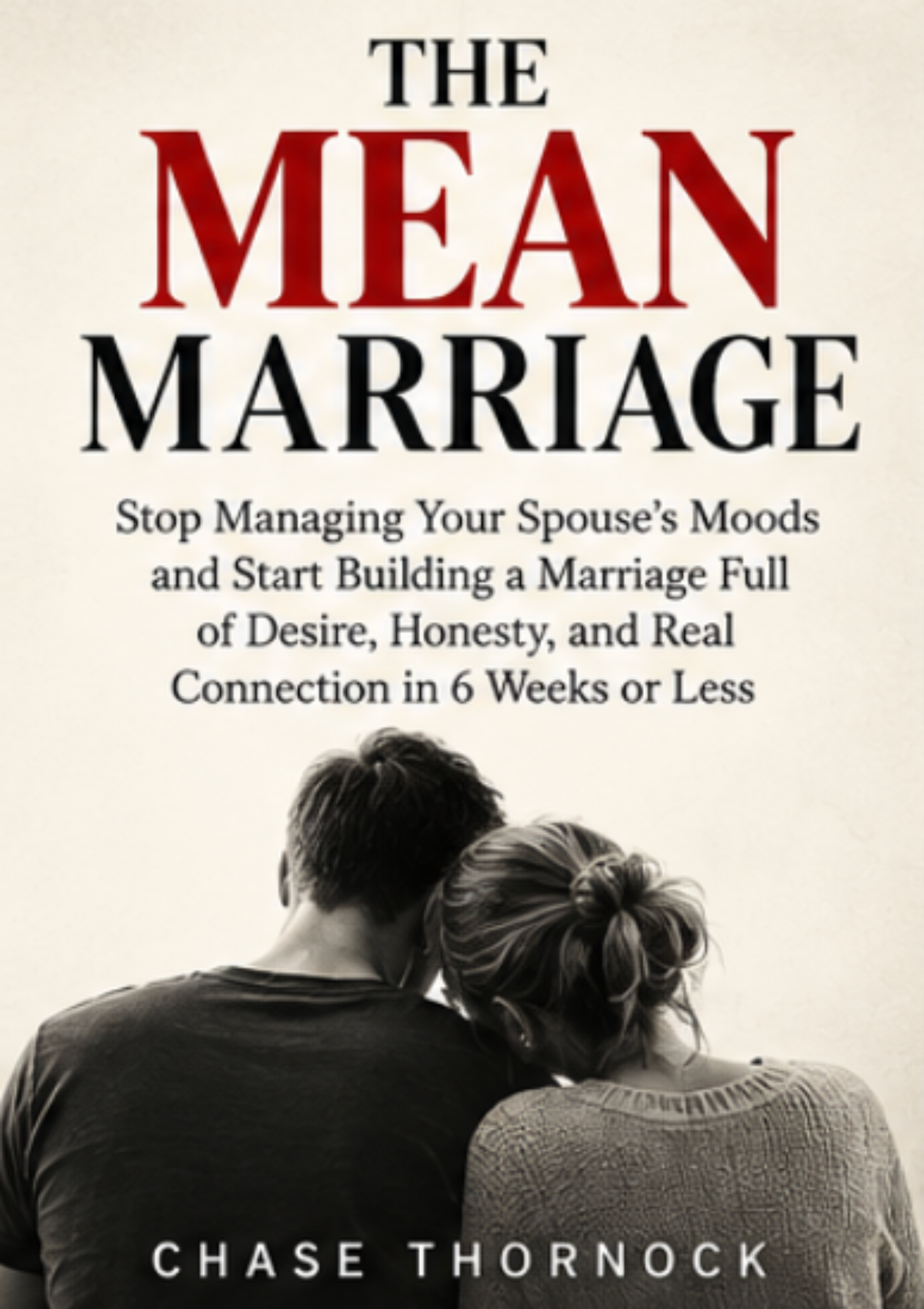
If you've become so good at keeping your husband happy that your own wants have gone quiet, The Mean Marriage walks you through five small steps that start in your body, so you can say the true thing warmly and let him answer however he answers, because you deserve to be wanted by him, not just relied on.

Yes! Rush me a copy, $20
Ebook only · Instant download

When keeping the peace starts to feel lonely

Someone asks where you want to eat, and "whatever you want" leaves your mouth before anything in you was consulted. It comes out warm. It comes out fast. And maybe a small voice somewhere behind your sternum says, that's not true.

Maybe you've noticed the other moments too. Lying next to a man you love and feeling strangely alone. Sex that has become one more thing to track, like the oil change. A hard conversation you got through so calmly that nothing came of it, and the next morning everything was pleasant and exactly the same.

The reasons sound sensible in your head:

"Things have been going well. I don't want to rock the boat."

"He's had a long week. This isn't the time."

"We've talked about this a hundred times. What's the point?"

And underneath, the sentence few women say out loud, even to a friend: "I've made myself easy to live with, but I don't really feel wanted anymore."

If this sounds familiar, you're not alone, and you're not broken. You probably don't have a communication problem either. You've read the books. You could explain your pattern to a therapist with footnotes.

The trouble sits upstream of the words. Somewhere along the way, your nervous system decided that your husband's disappointment is a threat it has to neutralise. Chase Thornock calls this the Good Spouse Trap, and no script survives contact with it.

Why being the good wife can leave you feeling less wanted

The belief goes like this: a good wife reads the room early, sees the dip coming and smooths it out before anyone has to feel it. Less friction means a healthier marriage.

It's easy to see why you'd believe it. Your mother called it maturity. Your friends call it a gift. Your husband benefits from it most days. A pattern that gets praised this often rarely gets looked at.

Look at what it does, though. When his mood becomes your job, there's no room left for either of you to be honest, or surprising, or wanted in the risky way wanting requires. He can appreciate you, the way you appreciate a reliable thermostat. As Chase puts it, nobody has ever lain awake longing for their thermostat.

The smoothing has a second secret. His disappointment lands in your chest, your body reads it as danger, and the fixing begins. Some of that care is for him. A good deal of it is for you.

You are not responsible for how your husband feels. He is not responsible for how you feel. That one sentence is where the book begins.

Why date nights, love languages and couples therapy keep wearing off

Day twelve after the retreat is when you hear your voice go careful again. The first eleven days were lovely. Then something small lands wrong, your shoulders rise, and "no, it's fine" comes out in the exact voice you drove three hours to unlearn.

The tools themselves are sound. I statements, love languages, scheduled date nights and therapy were all built by thoughtful people. They also all work on the mind.

The pattern lives in the half second before you speak, when your body has already decided his reaction is dangerous. An I statement delivered by a braced nervous system is still a managed statement, just wearing a holiday sweater. Two people who manage each other all week will manage each other over appetizers too.

There's one more cost. The better you get at absorbing the tension, the less your husband ever feels the distance. From his seat, the marriage looks fine. Why would anyone rework a marriage that looks fine?

Why I wrote this book

"I love you, but I don't think I can live with you."

My wife Carly said that to me. The girl of my dreams, the mother of our kids, the person I had organised most of my waking attention around keeping happy.

By any outside measure, I was a good husband. I anticipated needs, absorbed disappointment and kept the peace. Underneath it, I was secretly taking responsibility for how Carly felt. When she didn't feel the way I thought she should, I wanted to give up. I had a line that ran through my head so often I could have stitched it on a throw pillow: "Why am I trying so hard to only have it backfire on me?"

Then, in the hardest conversation we ever had, Carly said, "I wish you would just fight with me."

I put on my shoes and walked around the block, furious. Somewhere around the second corner I noticed a plan forming: keep walking until the anger wore off, then go back in and be calm about it.

That's when it clicked. I was angry at my wife, and my first instinct was to make sure she never found out.

She wasn't asking for conflict. She was asking for one unmanaged reaction, so she could find out who she was married to. I wrote this book for the person who can explain their marriage perfectly and still can't shift a single moment of it.

Why saying what you want works when better communication didn't

When you let your husband be disappointed without fixing it, you both get room to be honest again, and wanting has space to come back.

It works because it goes straight at the part the other tools miss. You stop asking your body to perform calm and start teaching it that a sting in the room is survivable.

Here's how it can sound. The garage door goes up at 6:40, twenty five minutes after he said he'd be home. You turn the burner down and say, warmly, "Hey, welcome home. I want you to come home on time, or call, please."

He stands there with his bag on his shoulder. "Oh. That kinda stings." He's allowed to feel a sting. You're allowed to have said it.

Later, you catch his sleeve by the dishwasher. "Will you kiss me? I want to feel close." It's a little stiff. Slightly too much nose. You let it be the kiss it is.

Three honest exchanges. Zero repair projects. Nobody lies awake wondering if they were too much.

The Shift 5: the method inside The Mean Marriage

The Shift 5 is the five step method Chase teaches in The Mean Marriage. It works at the root of the trap, the instant your body decides his mood is your problem, instead of at the level of better phrasing.

Two tools carry it. The C.A.N. Cradle shows you the chain reaction: a Cue (he pauses), an Assumption (I'm in trouble), a Nervous system response, and then the behaviour you didn't choose. The Mattress of Awareness is the split second of noticing you learn to slip in before the Assumption takes over.

If you'd like to see the whole method laid out, your copy of The Mean Marriage is waiting below.

Yes, I want The Mean Marriage. Send me my copy, $20
Ebook only · Instant download

The Shift 5

The 5 steps to saying what you want without walking on eggshells.

01
Sense Your Body
Notice the urge to fix or appease as it happens physically: the jaw setting, the pre-apology forming in your throat.
02
Honor Your Wants
Say what you want in one sentence, "I want ___ because I want to feel ___," without editing it for approval.
03
Intentionally Surrender
Surrender the how to God, and leave your husband free to answer yes, no or "ouch."
04
Fearlessly Expand
Practise honesty and receiving affection through the discomfort, without correcting how the affection arrives.
05
Trim the Sails
Adjust with compassion after a miss, and run the loop again.

What Others Are Saying

"More ownership, less defensiveness."

— Tyler, attorney

"He finally helped me understand how all the things I already knew fit together."

— Shared by nurses, doctors and therapists who have done this work

"We moved further, faster, and more deeply than we had in years of prior counseling."

— Emily, registered nurse

How one wife stopped policing her husband and started enjoying him

Hannah came in anxious and critical, and she'd earned both. She watched her husband John's parenting the way a lifeguard watches a toddler near the deep end. Every tone got logged. Every missed moment got corrected. Her theory was airtight: if John would parent differently, she could finally relax.

Chase never tried to talk her into believing John's rough moments were fine. The shift came when one truth settled in her body: he didn't have to change for her to be okay.

The watching loosened. A rough bedtime became a rough bedtime. And one day she looked across the kitchen at the same husband, parenting the same way, and saw a man she admired.

Afterward she said she could finally "love and enjoy him in a way I couldn't before." Love and enjoy. Tolerance uses different verbs, and they all involve the jaw.

More from people who have done the work

"Tyler could narrate his patterns like a closing argument. His word for where all that insight left him was "high-centered," like a truck resting on a rock with the wheels spinning. His wife didn't get gentler. Her frustration simply stopped landing as an accusation he had to answer. His summary: "a lot cheaper than a divorce.""

— Tyler, attorney, after twenty years of therapy

"Kim anticipated, smoothed and gave so well that everyone, including Kim, assumed it was her personality. She said one true want, in the positive, and then waited. No softening, no apology. Those quiet seconds did more for her marriage than years of carefully managed conversations."

— Kim, the emotional engine of her marriage for years

"After a raw, honest night, Stephanie told Chase she wanted to get so good at this that she'd never feel that uncomfortable again. His answer: "My goal for you is to feel this way as often as possible." The discomfort turned out to be what connection looked like while it was arriving."

— Stephanie, mid-practice
Yes, I want The Mean Marriage. Send me my copy, $20
Instant download

What You'll Discover Inside

01
What "mean" actually means in a marriage
Risking his disappointment while staying honest and warm, and why plain honesty can feel cruel to a body trained in management.
02
Which of your good qualities is keeping you stuck
A short checklist ("I'm very patient," "We never fight") reveals which virtue is quietly running the trap.
03
Four habits that look like kindness and keep you stuck
Waiting for the right moment, the marriage that never fights, the selfish question and the helper, each with a self-check.
04
How a pause from your husband turns into a verdict
The C.A.N. Cradle, the chain from cue to assumption to reaction, explained through a seven year old, an infomercial and a brother's badly timed fart.
05
Where to catch yourself before you fold
The Mattress of Awareness, the split second of noticing, and why the first version is always in hindsight (which still counts).
06
How to read your body in the thirty seconds before you speak
A four line body report (breath, jaw, stomach, hands), plus the ballroom lesson Carly calls "turtle mode."
07
The exact sentence for saying what you want
Why "I need," "you should" and "I don't want" all sneak management back in, and what to say instead.
08
How to receive affection without fixing it
The kiss on the cheek instead of the mouth, and why accepting it as given may be harder than saying the hard thing.
09
A 48-hour challenge to let him be disappointed without fixing it
Two days of letting him be disappointed without rescuing him, warm the whole time.
10
Four honest choices for any marriage
Ask, hold, stay or leave, and the daily question that brings the spark of choosing back.

Is This Right For You?

This is NOT for those who:
  • want permission to stop caring and call it a boundary
  • need their husband to change first
  • are hoping for better vocabulary to finally prove they were right
  • plan to read it with a highlighter aimed at his patterns (the people who buy this book usually also sent the podcast)
This is for:
  • The woman who is known as the thoughtful one, the steady one, the one who holds it together
  • The woman who has started to suspect that holding it together has a price
  • The woman who has tried the insight and would like to live it
Yes, I want The Mean Marriage. Send me my copy, $20
Ebook only · Instant download

Frequently Asked Questions

Is this just another communication book?
No. Most marriage books teach you what to say. This one works on why your body won't let you say it, even when you know the perfect sentence.
Does my husband need to read it too?
He doesn't. Every step of The Shift 5 happens on your side of the bed. One honest person is enough to start, and one is also exactly how many people you can control.
Does "mean" mean cold or harsh?
Not at all. Withholding, punishing and going cold are nowhere in the book. Mean means saying the true thing, letting him have a feeling about it, and staying kind and in the room.
I've done years of therapy. Will this feel repetitive?
Many readers arrive exactly there. Tyler had twenty years of therapy behind him. This picks up where insight stops: in the body, in the half second when the pattern fires.
Do I need to understand nervous system science?
You don't. Emily could explain the science better than most, and it mostly kept her at arm's length from her own sensations. What helps is feeling it, and the book gives you short prompts for that.
How quickly will I notice anything?
At first you'll likely catch the pattern after it happens, lying in bed replaying the evening. That's the expected start. With practice, you begin catching it while it's happening.
Chase Thornock

Chase Thornock.

Chase Thornock is a nervous system coach and the creator of the Stress Reflex framework. He works with people who have already tried therapy, mindset work and willpower and are still caught in the same cycle.

He grew up in a step-family full of big personalities and big feelings, where reading the room was how a kid stayed safe. At seven, during an infomercial filmed in his family's living room, he smoothed things over with his mom and then his stepdad, in that order, and a rule got written: I must be the one who stabilises everything. Everyone called it a gift.

He carried that rule into running a venture-backed fintech company and into his marriage. A mentor, a former Goldman Sachs investment banker, finally told him, "When you're helping people heal their lives and heal their marriages, you light up." Saying yes meant admitting his own marriage had been in serious trouble.

Chase and Carly have three kids, competed in ballroom for years, and still have the occasional spiral conversation after thirty hours of travel. Carly finds his people reading a little creepy and endlessly entertaining. She also considers herself best friends with Taylor Swift, which comes up in the book for good reason. Chase and his team are there with you, and you're welcome to reach out with questions any time.

His mission fits in four words: Hear Anything, Say Anything.

Feel wanted and free to be honest, in the same marriage

Feel wanted again
and say what you want
without walking on eggshells

Imagine saying "I want to feel close" at the sink and taking the slightly crooked kiss as it comes, then waking up still feeling like yourself. It starts with one true sentence.

Yes, I want The Mean Marriage. Send me my copy, $20
30-day refund · Ebook only · Instant download